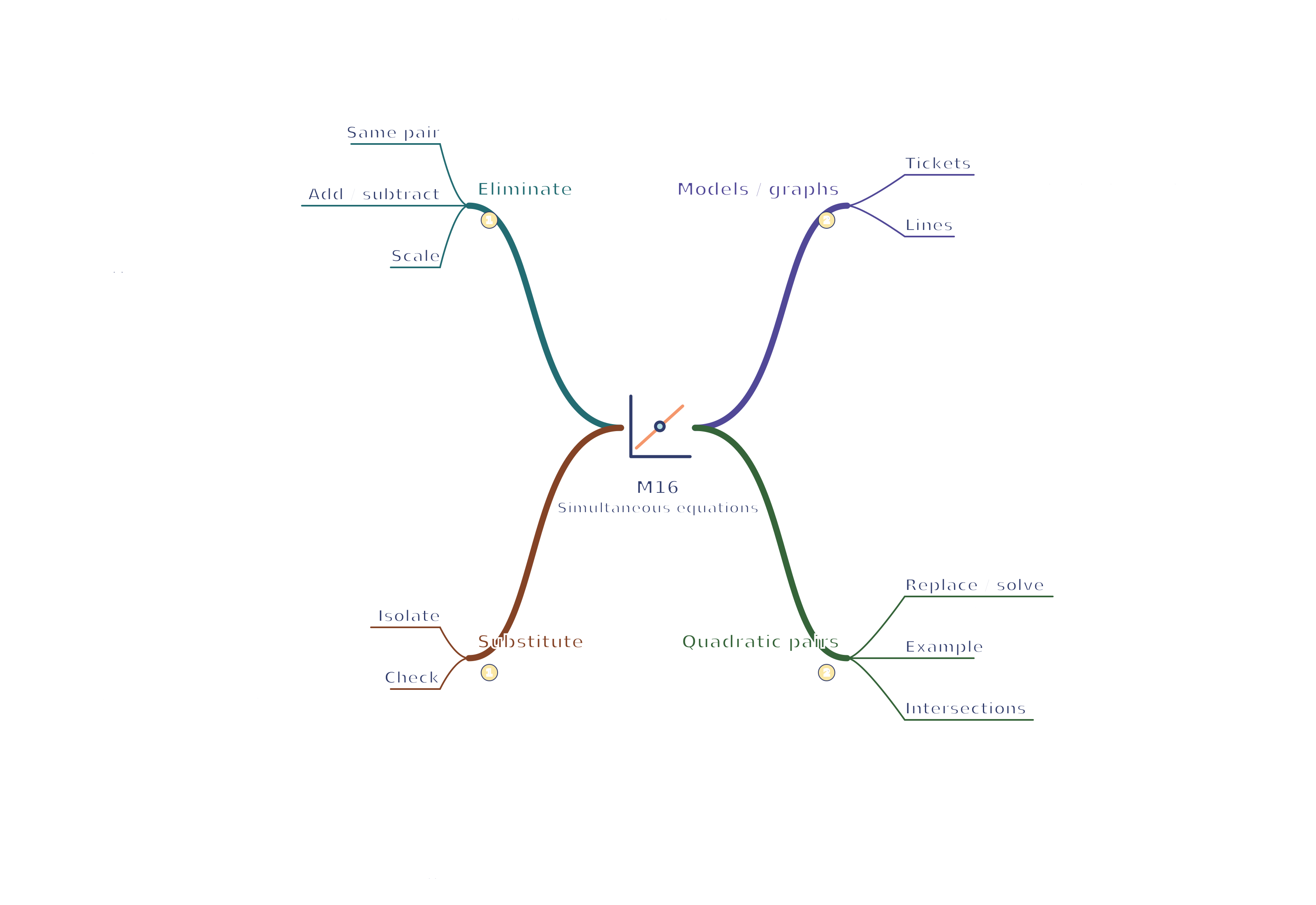
Revision notes, worked examples and methods for simultaneous equations.
Notes and quizzes ready · 50 questions · Revision video ready.
Foundation shows shared notes and questions. Higher includes the shared content and labelled Higher extensions. Changing tier starts the notes and a new quiz set.
Revise the key ideas
Linear simultaneous equations
Simultaneous equations must both be true for the same pair of values. Their solution is the intersection of their graphs. Intersection of x plus y equals seven and x minus y equals one
Elimination adds or subtracts equations to remove a variable. If its coefficients are equal, subtract; if they are opposites, add.
Worked example: x + y = 7 and x − y = 1. Add to get 2x = 8, so x = 4. Substitute into x + y = 7 to obtain y = 3.
Worked example: 2x + 3y = 13 and 3x + 2y = 12. Multiply the first by 3 and the second by 2 to obtain 6x + 9y = 39 and 6x + 4y = 24. Subtract: 5y = 15, so y = 3 and x = 2.
When multiplying an equation, multiply every term on both sides. Keep negative signs and the equals sign aligned when eliminating.
Substitution is useful if one variable is already isolated. From y = 2x + 1 and x + y = 10, substitute: x + 2x + 1 = 10, giving x = 3 and y = 7.
Check a candidate pair in both original equations. Satisfying one equation alone is not enough.
Modelling and graphical solutions
Worked example: Two adult and three child tickets cost £31; three adult and two child tickets cost £34. Set 2a + 3c = 31 and 3a + 2c = 34. Eliminating gives c = £5 and a = £8.
Graphical intersections give approximate solutions limited by scale. Parallel distinct lines have no solution; equations describing the same line have infinitely many pairs.
Define the variables with units before modelling, and interpret the pair in the context rather than reporting bare x and y values.
Higher — linear and quadratic pairs
Substitute the linear expression into the quadratic equation to obtain an equation in one variable. Solve it, then recover the other coordinate for each root.
Worked example: y = x + 2 and y = x2. Set x2 = x + 2, giving (x − 2)(x + 1) = 0. The solutions are (2, 4) and (−1, 1). Intersections of y equals x plus two and y equals x squared
For x2 + y2 = 25 and y = x + 1, substitute the whole bracket: x2 + (x + 1)2 = 25. Expand before solving; (x + 1)2 is not x2 + 1.
A line can meet a parabola or circle twice, once or not at all. Keep corresponding x and y values paired; do not mix coordinates from different solutions.
Test yourself
50 questions · Sets of 10 from the selected tier. For fractions, use / when typing; for powers, use superscripts or ^. Follow each question's answer format. These quick checks support revision; practise full written solutions and proofs too.
Watch M16 · Simultaneous equations
Revise simultaneous equations with this narrated video. Use the player controls to pause, seek, adjust the volume or mute. Turn English captions on or off using the captions menu.
 Mr Kidman's Classroom