Revision notes, worked examples and methods for algebraic arguments and proof.
Notes and quizzes ready · 50 questions · Revision video ready.
Foundation shows shared notes and questions. Higher includes the shared content and labelled Higher extensions. Changing tier starts the notes and a new quiz set.
Revise the key ideas
Equations, identities and arguments
An equation is true for particular values: 2x + 1 = 7 holds when x = 3. An identity holds for every allowed value, for example 2(x + 3) ≡ 2x + 6.
To show expressions are equivalent, expand or factorise and collect terms until they have the same form. Testing a single value cannot prove an identity.
Worked example: 3(x + 2) − x = 3x + 6 − x = 2x + 6 = 2(x + 3), so the two expressions are equivalent for every x.
A counterexample disproves a universal claim. The statement “all prime numbers are odd” is false because 2 is prime and even.
Use precise mathematical reasons in an argument. A diagram that looks correct or a few numerical examples are evidence to investigate, not a proof for every case.
Consecutive integers can be written n, n + 1, n + 2; an even integer as 2n; an odd integer as 2n + 1, with n an integer.
Higher — algebraic proofs
To prove a divisibility statement, express the result as the divisor times an integer. Define the integer variables and show each step clearly.
Worked example: The sum of two odd integers is (2m + 1) + (2n + 1) = 2(m + n + 1). Since m + n + 1 is an integer, the sum is even.
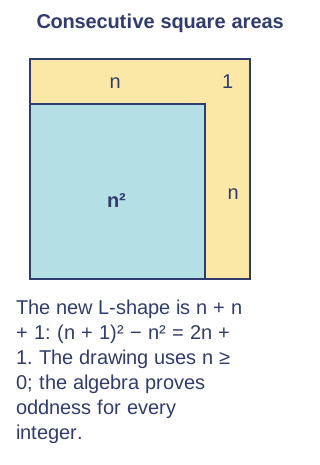
Worked example: The difference of consecutive squares is (n + 1)2 − n2 = 2n + 1, which is odd for every integer n.
Worked example: Three consecutive integers sum to n + (n + 1) + (n + 2) = 3(n + 1), so their sum is a multiple of 3.
For an odd square, (2n + 1)2 = 4n2 + 4n + 1 = 4n(n + 1) + 1. Hence its remainder on division by 4 is 1.
Distinguish a proof from solving an equation. Proving an identity must not impose a special value of x; every operation must be valid across the stated domain.
To disprove “x2 is always greater than x”, use x = 12: x2 = 14 < 12. Consider values beyond positive integers when a claim concerns real numbers.
Test yourself
50 questions · Sets of 10 from the selected tier. For fractions, use / when typing; for powers, use superscripts or ^. Follow each question's answer format. These quick checks support revision; practise full written solutions and proofs too.
Watch M17 · Algebraic arguments and proof
Revise algebraic arguments and proof with this narrated video. Use the player controls to pause, seek, adjust the volume or mute. Turn English captions on or off using the captions menu.
 Mr Kidman's Classroom