Addition and condensation polymers, structures, uses and disposal
Revise the key ideas
Addition polymerisation and structures
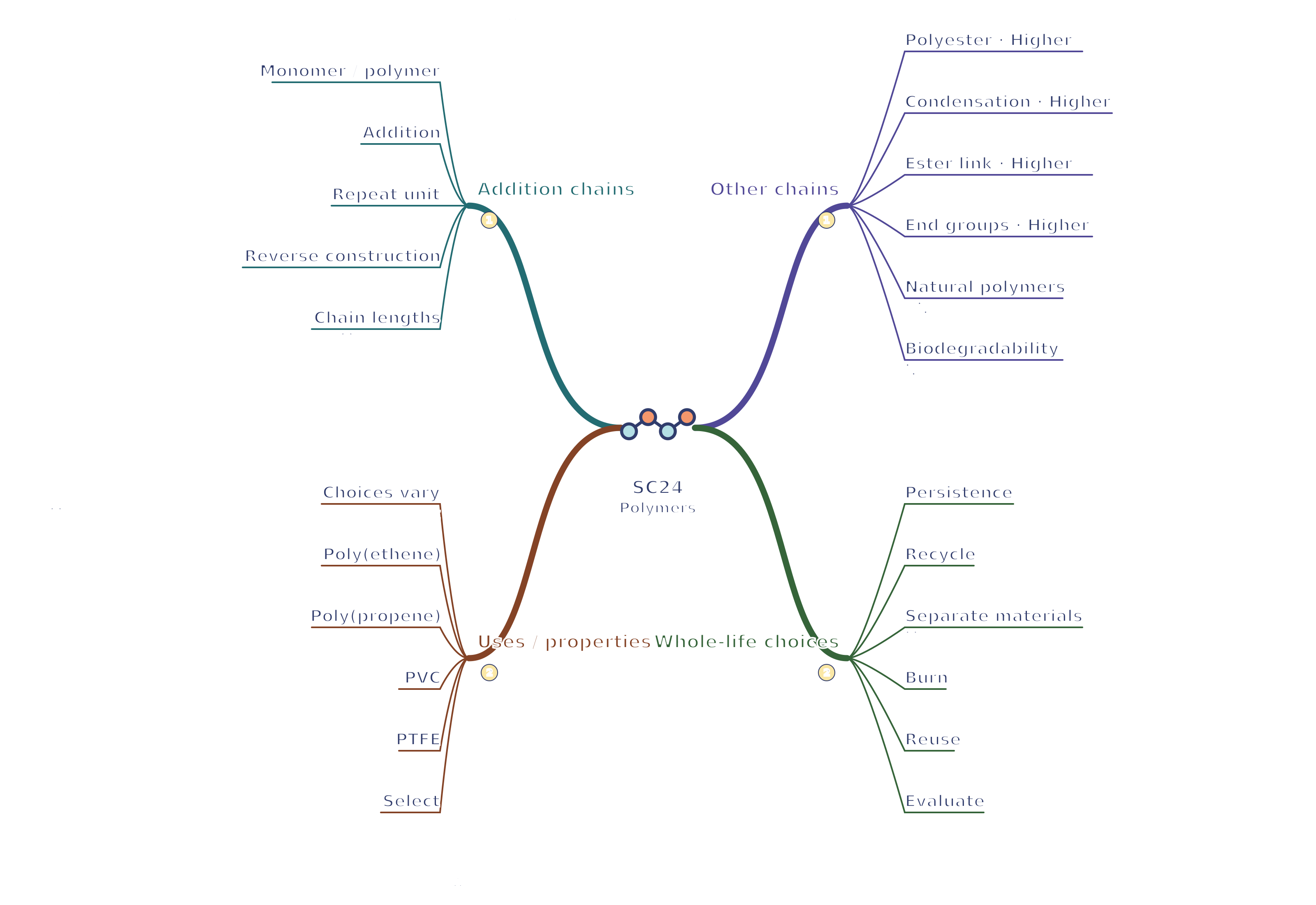
A polymer is a substance made from many repeating units linked together, giving a high average relative molecular mass. A monomer is a small molecule that can join into a polymer chain.
In addition polymerisation, monomers containing C=C add together. The double bond opens to form single bonds linking a chain; no small-molecule by-product is lost.
Ethene forms poly(ethene). Draw a repeat unit with a single C–C bond, two hydrogens on each carbon, continuation bonds crossing brackets, and n outside the brackets; the bracketed unit is part of a chain, not an isolated ethane molecule.Continuation bonds cross the brackets; n represents many repeating units.
Propene forms poly(propene), with a CH₃ side group on alternate backbone carbons. Chloroethene forms poly(chloroethene), PVC, with a chlorine side group; tetrafluoroethene forms PTFE, with fluorine atoms replacing the hydrogens.
To obtain an addition monomer from a repeat unit, identify the two backbone carbons and restore the C=C bond between them, keeping their side groups. To obtain the repeat unit from a monomer, open C=C and draw chain continuation bonds.
Polymer molecules have different chain lengths, so their relative molecular masses form a distribution and are described with an average. Longer chains and chain interactions can affect material properties.
Different monomers and processing produce polymers with different properties. Polymer does not mean a single material with one melting behaviour or strength.
Properties and uses
Poly(ethene) can be flexible and water-resistant, useful for bags, packaging and bottles; grades differ in stiffness and density.
Poly(propene) is tough and light, useful for containers, fibres and some reusable hinges. Select it from property data rather than assuming all plastics are interchangeable.
PVC can be rigid for pipes or window frames, or made flexible with plasticisers for cable insulation. Its electrical insulation and durability are useful, but disposal requires care.
PTFE is chemically resistant, slippery and heat-resistant for many uses, including non-stick coatings. It is not an excuse to ignore manufacturer temperature limits.
Compare polymer properties with the demands of a product: flexibility, toughness, density, electrical insulation, chemical resistance, heat resistance and cost. A useful property in one setting can be a disadvantage in another.
Condensation polymers and natural polymers
(Higher tier) A polyester can form when a molecule with two carboxylic-acid groups reacts with a molecule with two alcohol groups. Two functional groups on each monomer allow growth in both directions.
(Higher tier) A carboxylic-acid group reacts with an alcohol group to form an ester link, releasing a water molecule. Repeating this forms a polyester by condensation polymerisation. Unlike addition polymerisation, a small molecule is released when each link forms.A diacid and a diol can form many ester links along a polyester chain.
(Higher tier) The ester link contains –C(=O)–O–. Draw both carbonyl and single-bonded oxygens; the water comes from an –OH of the acid and a hydrogen from the alcohol group.
(Higher tier) Each monomer with two functional groups can join at both ends. If k such molecules join to make one straight chain with no rings, they form k − 1 links and release k − 1 water molecules. Repeat-unit drawings show the repeating pattern rather than the chain’s end groups.
DNA is a natural polymer of nucleotides; four different nucleotide types are used. Starch is based on sugar monomers, while proteins are polymers of amino acids.
Natural and synthetic polymers can have very different biodegradability and properties. Being a polymer alone does not establish whether a material will persist in landfill.
Disposal, recycling and environmental choices
Many conventional synthetic polymers are not readily biodegradable and can persist in landfill or the environment. Litter and fragmented plastic can affect wildlife; landfill persistence is separate from toxicity.
Making polymers often uses finite petrochemical resources. Recycling can reduce demand for new feedstock, but collection, sorting, cleaning and processing require energy and money.
Different polymers must usually be separated before melting and reforming, because mixed materials can produce poor-quality products. Contamination and additives can complicate recycling.
Burning polymers can recover energy but produces carbon dioxide and may release harmful gases depending on composition and conditions; chlorine-containing polymers can produce acidic gases. Controlled emissions treatment is needed.
Reuse can avoid repeated manufacture when products are durable and used enough times. Compare whole-life data, transport, washing, breakage and disposal rather than assuming reuse always wins for every scenario.
Choose disposal routes using economic costs, available collection systems, recovered material quality, energy use and environmental effects. Recycling rates and theoretical recyclability are different claims.
Revise polymers with this narrated video. Use the player controls to pause, seek, adjust the volume or mute. Turn English captions on or off using the captions menu.
 Mr Kidman's Classroom