A reversible reaction can proceed in both directions: products can react to reform reactants. The symbol ⇌ shows forward and reverse processes.
Changing conditions can favour one direction. Reversibility is chemical reaction in both directions, not just two unrelated processes.
When ammonium chloride is heated, it can decompose to ammonia and hydrogen chloride gases: NH₄Cl(s) ⇌ NH₃(g) + HCl(g).
On cooling, ammonia and hydrogen chloride recombine to form solid ammonium chloride. The second gas is hydrogen chloride, not hydrogen.The gaseous products are ammonia and hydrogen chloride, not hydrogen.
The forward and reverse reactions have opposite energy changes: if one is exothermic, the reverse is endothermic. Heating can favour the endothermic direction.
This decomposition is a supervised demonstration using suitable ventilation and safety controls; the gases are not suitable for an unsupervised home experiment.
Dynamic equilibrium
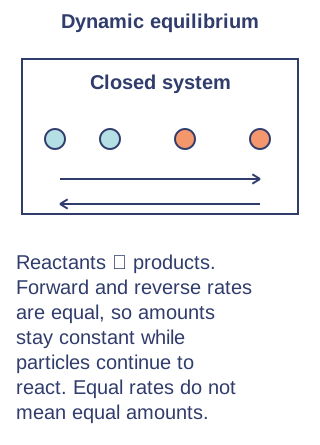
A reversible reaction can reach dynamic equilibrium in a closed system, where reactants and products cannot escape.
At equilibrium the forward and reverse reactions continue at equal rates. “Dynamic” means reactions are still happening at particle level.
The amounts or concentrations of reactants and products remain constant while conditions remain unchanged. They do not have to be equal to each other.
Starting with reactants only, the forward rate can initially be high while the reverse rate is zero. As product forms, the reverse rate rises until both match.At equilibrium reactions continue; their rates match rather than becoming zero.
If products escape from an open system, the reverse reaction may not establish the same equilibrium. Closed-system conditions matter.
The equilibrium position describes how much reactant and product the mixture contains. An equilibrium further to the right has a greater proportion of products; further to the left means a greater proportion of reactants.
Changing equilibrium conditions (Higher tier)
A change in conditions disturbs an equilibrium; the system responds in a direction that partly opposes the change until a new equilibrium is reached.
Increasing a reactant's concentration favours the direction that uses it, often forward. Removing a product can favour more product formation; adding product tends to favour the reverse reaction.
Increasing temperature favours the endothermic direction. Decreasing temperature favours the exothermic direction. Use the energy change of the stated forward reaction.
Increasing pressure favours the side with fewer gaseous particles; decreasing pressure favours more gaseous particles. Count gaseous coefficients, not atoms or solids.Concentration changes favour consuming what was added or replacing what was removed.
If both sides have equal numbers of gaseous particles, pressure change has no equilibrium-position effect in this model. Solid and liquid terms do not count towards the gaseous total.
A catalyst speeds both forward and reverse reactions and reaches equilibrium sooner. It does not change equilibrium position or the equilibrium yield at the same conditions.
Rate and equilibrium yield are different: conditions giving more product at equilibrium may make the reaction too slow for an economical process.
The Haber process
The Haber process makes ammonia by the reversible reaction N₂(g) + 3H₂(g) ⇌ 2NH₃(g). Nitrogen is obtained from air and hydrogen commonly from natural gas.
The forward reaction is exothermic. Four moles of reactant gas correspond to two moles of product gas, so pressure favours the product side.Count coefficients of gases, not the total atoms in their molecules.
The specified industrial conditions are about 450 °C, about 200 atmospheres and an iron catalyst. These are a practical compromise, not conditions giving the greatest possible equilibrium yield.
A lower temperature gives a higher equilibrium ammonia yield but a slower rate. A moderate high temperature allows useful production speed with a lower equilibrium yield.
Higher pressure increases equilibrium yield and can increase rate, but compression and strong equipment cost energy and money. Very high pressure is not automatically the best economic choice.
The iron catalyst gives a faster rate without increasing equilibrium yield. It lets the process operate efficiently under the chosen conditions.
Ammonia is cooled so it condenses and can be removed. Unreacted nitrogen and hydrogen are recycled through the reactor. This uses the starting materials more efficiently, even though only some react each time through.Recycling improves overall conversion without requiring complete reaction in one pass.
Applying the rules to evidence
For exothermic N₂ + 3H₂ ⇌ 2NH₃, raising temperature shifts left, raising pressure shifts right, and removing ammonia favours further ammonia formation.
For an endothermic forward reaction, heating instead shifts right. Always identify which written direction is endothermic before making a temperature prediction.
For H₂(g) + I₂(g) ⇌ 2HI(g), gaseous totals are two on both sides, so a pressure change does not change equilibrium position in this GCSE model.
On a rate–time graph, equilibrium begins where forward and reverse rates are equal and stay equal. On a concentration–time graph, constant values need not have the same height.
Explain industrial conditions with both chemistry and costs. “High temperature makes more ammonia” is wrong for equilibrium yield even though heating increases rate.
Watch SC12 · Reversible reactions and equilibria · Topic 4 — Extracting metals and equilibria
Revise reversible reactions and equilibria with this narrated video. Use the player controls to pause, seek, adjust the volume or mute. Turn English captions on or off using the captions menu.
 Mr Kidman's Classroom