Revision notes, worked examples and methods for pythagoras and right-angle trigonometry.
Notes and quizzes ready · 50 questions · Revision video ready.
Foundation shows shared notes and questions. Higher includes the shared content and labelled Higher extensions. Changing tier starts the notes and a new quiz set.
Revise the key ideas
Pythagoras' theorem
In a right-angled triangle, a2 + b2 = c2, where c is the hypotenuse opposite the right angle. The theorem does not apply directly to a non-right-angled triangle. A three four five right triangle
To find the hypotenuse, add the other squared sides and square root: for legs 3 cm and 4 cm, c = √(9 + 16) = 5 cm.
To find a shorter side, subtract before taking the square root: a = √(c2 − b2). If c = 13 cm and b = 5 cm, a = √144 = 12 cm.
Pythagoras also gives distance between coordinates: length = √((x₂ − x₁)2 + (y₂ − y₁)2). From (1, 2) to (4, 6), the distance is 5 units.
Right-angle trigonometry
Relative to the chosen angle θ, label opposite, adjacent and hypotenuse. Opposite and adjacent swap when the angle changes; the hypotenuse stays opposite the right angle.
SOH CAH TOA means sin θ = oppositehypotenuse, cos θ = adjacenthypotenuse, and tan θ = oppositeadjacent.
Choose the ratio using the known and required sides. Worked example: Opposite x, hypotenuse 10 cm and angle 30° give sin 30° = x10, so x = 5 cm.
Worked example: Adjacent 7 cm and angle 40° with hypotenuse h give cos 40° = 7h, so h = 7cos 40° ≈ 9.14 cm.
To find an angle, use the inverse trig key. Opposite 3 and adjacent 4 give θ = tan−1(34) ≈ 36.9°. Here tan−1 is inverse tangent, not a reciprocal.
Set the calculator to degrees. Check that a hypotenuse is the longest side and that each acute angle in a right triangle is between 0° and 90°.
Exact values and applications
Exact sine values for 0°, 30°, 45°, 60°, 90° are 0, 12, √22, √32, 1. Cosine values in the same order are 1, √32, √22, 12, 0.
Exact tangent values for 0°, 30°, 45°, 60° are 0, √33, 1, √3. tan 90° is undefined. The 45° and 30°/60° special triangles explain these values. Exact-value right triangles
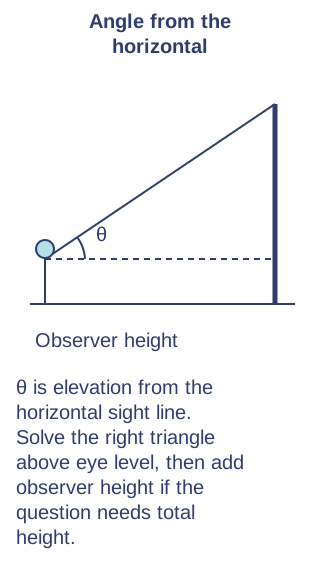
Angles of elevation/depression are measured from horizontal lines, not vertical ones. Sketch a right triangle, mark the angle and include any observer height in the final total if needed.
Higher — three-dimensional problems
Find a useful right triangle inside the solid, often using Pythagoras once for a face diagonal and again for a space diagonal. Keep the face diagonal exact during the calculation.
Worked example: A cuboid 3 cm by 4 cm by 12 cm has base diagonal 5 cm and space diagonal √(52 + 122) = 13 cm. The angle the space diagonal makes with the base is tan−1(125) ≈ 67.4°.
The space diagonal, its 5 cm projection on the base and the 12 cm vertical edge form the right triangle used in this example. Label that triangle separately from the solid if the perspective view is confusing. Right triangle for a cuboid space diagonal
For an angle between a line and a plane, use the angle between the line and its projection onto the plane. A three-dimensional sketch alone may make the relevant right angle hard to see.
Test yourself
50 questions · Sets of 10 from the selected tier. For fractions, use / when typing; for powers, use superscripts or ^. Follow each question's answer format. These quick checks support revision; practise full written solutions and proofs too.
Watch M32 · Pythagoras and right-angle trigonometry
Revise pythagoras and right-angle trigonometry with this narrated video. Use the player controls to pause, seek, adjust the volume or mute. Turn English captions on or off using the captions menu.
 Mr Kidman's Classroom