Revision notes, worked examples and methods for linear equations and inequalities.
Notes and quizzes ready · 52 questions · Revision video ready.
Foundation shows shared notes and questions. Higher includes the shared content and labelled Higher extensions. Changing tier starts the notes and a new quiz set.
Revise the key ideas
Solving equations
An equation's solution makes both sides equal. Keep an equation balanced by doing the same operation to each side; inverse operations help isolate the unknown.
Worked example: 5x − 7 = 18 gives 5x = 25 and x = 5. Check: 5 × 5 − 7 = 18.
Worked example: 4(x − 2) = 2x + 10 gives 4x − 8 = 2x + 10, then 2x = 18, so x = 9. Expand and collect before dividing.
For equations with fractions, multiply every term by a common denominator: x3 + 2 = 5 gives x + 6 = 15, so x = 9.
To form an equation, define the unknown. Three consecutive integers can be n, n + 1 and n + 2; if their sum is 24, 3n + 3 = 24, so they are 7, 8 and 9.
Graphically, solve f(x) = g(x) by reading the x-coordinates of intersections. The graph gives approximate solutions if its scale does not allow exact readings.
Inequalities and number lines
Solve a linear inequality like an equation, except multiplying or dividing by a negative number reverses the inequality sign. For −2x < 6, x > −3.
Worked example: 3x + 2 ≤ 14 gives 3x ≤ 12 and x ≤ 4. Equality is allowed, so 4 is included.
On a number line, use an open circle for < or > and a filled circle for ≤ or ≥. Shade or draw an arrow in the direction of the allowed values. Number line for x less than or equal to four
For a double inequality, apply each operation to all three parts: 2 < 3x + 5 ≤ 11 gives −1 < x ≤ 2. The integer solutions are 0, 1 and 2.
The answer x < 4 describes infinitely many real numbers unless the question restricts x to integers. List integer solutions only when asked.
Higher — regions and set notation
Set notation {x : x ≥ 2} means the set of x values satisfying x ≥ 2. Intersection means all conditions apply at once; union combines values allowed by either condition.
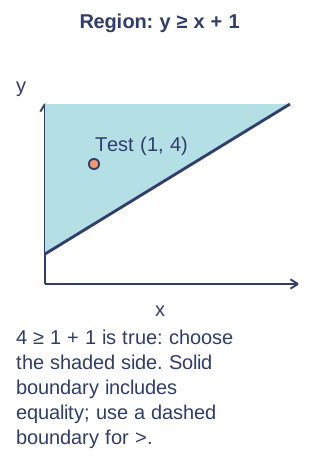
For an inequality in two variables, first draw its boundary line. Use a solid line if equality is allowed and a dashed line if it is not.
Test a point off the line to decide which side is allowed. For y > 2x + 1, (0, 0) fails, so the region is on the other side of the boundary.
For simultaneous inequalities, the solution is their overlapping region. State clearly whether the shaded region is the allowed region or the excluded region.
Test yourself
52 questions · Sets of 10 from the selected tier. For fractions, use / when typing; for powers, use superscripts or ^. Follow each question's answer format. These quick checks support revision; practise full written solutions and proofs too.
Watch M10 · Linear equations and inequalities
Revise linear equations and inequalities with this narrated video. Use the player controls to pause, seek, adjust the volume or mute. Turn English captions on or off using the captions menu.
 Mr Kidman's Classroom