Revision notes, worked examples and methods for functions and graph transformations.
Notes and quizzes ready · 50 questions · Revision video ready.
This topic is Higher-only.
Revise the key ideas
Higher — function notation
f(x) denotes the output of function f for input x; it does not mean f multiplied by x. If f(x) = 3x − 2, then f(4) = 10.
The domain is the permitted input set and the range is the resulting output set. For f(x) = 1x, x = 0 is excluded.
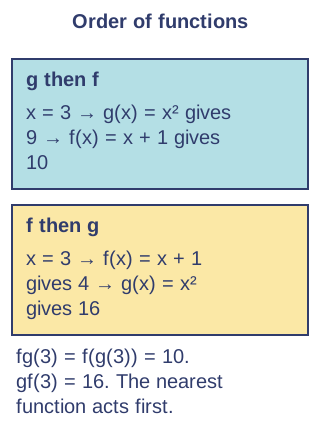
A composite function applies one function then another. fg(x) means f(g(x)): the function nearest x acts first.
Worked example: f(x) = 2x + 1 and g(x) = x2. fg(3) = f(9) = 19, but gf(3) = g(7) = 49. Composition order matters.
The inverse f−1 reverses a function; it is not its reciprocal. To find an inverse, write y = f(x), solve for x in terms of y, then exchange the letters.
Worked example: y = 3x − 2 gives x = y + 23, so f−1(x) = x + 23. Applying f and then f−1 restores an allowed input.
A function must be one-to-one on its chosen domain to have an inverse function. x2 on all real inputs is not one-to-one; restricting to x ≥ 0 permits inverse √x.
Higher — graph translations
y = f(x) + a moves the graph up a units; y = f(x) − a moves it down a. Every y-coordinate changes by the same amount.
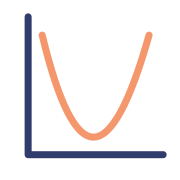
y = f(x − a) moves the graph right a units, whereas y = f(x + a) moves it left a. The sign inside the function often causes mistakes. A parabola translated two right and three up
Worked example: y = (x − 2)2 + 3 is y = x2 translated 2 right and 3 up. Its turning point is (2, 3).
Higher — graph reflections
y = −f(x) reflects a graph in the x-axis: (x, y) becomes (x, −y). y = f(−x) reflects it in the y-axis: (x, y) becomes (−x, y).
For y = √x, the graph of y = −√x lies below the x-axis with the same non-negative inputs. y = √(−x) instead lies to the left and requires x ≤ 0.
Track a distinctive point and any asymptotes through a transformation. For y = 1x − 2 + 3, asymptotes move from x = 0, y = 0 to x = 2, y = 3.
Check a translated point by substitution. A graph's equation, domain and intercepts must agree with the described movement.
Test yourself
50 questions · Sets of 10 from the selected tier. For fractions, use / when typing; for powers, use superscripts or ^. Follow each question's answer format. These quick checks support revision; practise full written solutions and proofs too.
Watch M19 · Functions and graph transformations
Revise functions and graph transformations with this narrated video. Use the player controls to pause, seek, adjust the volume or mute. Turn English captions on or off using the captions menu.
 Mr Kidman's Classroom