Revision notes, worked examples and methods for similarity and proportional measures.
Notes and quizzes ready · 50 questions · Revision video ready.
Foundation shows shared notes and questions. Higher includes the shared content and labelled Higher extensions. Changing tier starts the notes and a new quiz set.
Revise the key ideas
Similar figures and scale factors
Similar figures have equal corresponding angles and proportional corresponding lengths. Congruent figures are the same size and shape, so their length scale factor is 1.
Identify corresponding sides using matching angles and position, rather than choosing sides simply because they look similar on the diagram.
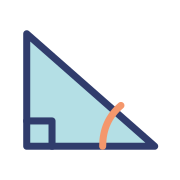
Length scale factor from a smaller figure to a larger figure is corresponding large lengthcorresponding small length. All corresponding lengths use the same factor. Two similar right-angled triangles
Worked example: A side of 4 cm corresponds to 10 cm, so scale factor is 2.5. A corresponding 6 cm side becomes 15 cm; reversing the enlargement uses factor 0.4.
For similar triangles, equal angles establish the same shape (AA similarity). This is not a congruence test: equal angles alone do not force equal side lengths.
Trigonometric ratios stay constant in similar right-angled triangles because corresponding sides scale together. This is why sin θ, cos θ and tan θ depend on the angle.
Perimeters scale by the length factor. If each length triples, a perimeter of 18 cm becomes 54 cm.
Higher — area and volume scaling
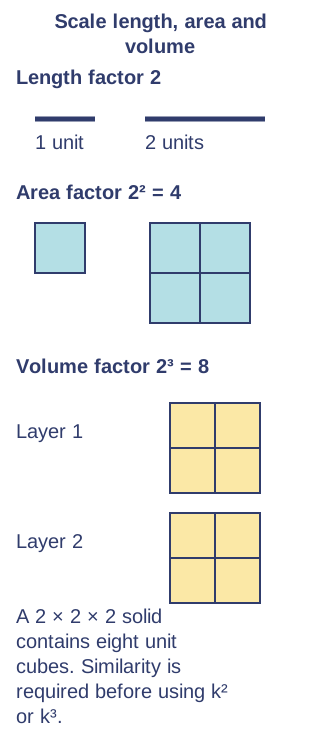
When the length factor is k, the area factor is k2 and the volume factor for similar solids is k3. Different dimensions require different powers.
Worked example: Similar shapes with length ratio 2 : 5 have area ratio 4 : 25. An area of 12 cm2 on the smaller shape corresponds to 12 × 254 = 75 cm2.
Worked example: Similar solids have length factor 3. Their volumes have factor 27, so a volume of 20 cm3 becomes 540 cm3.
To recover the length factor from an area factor, take a square root. An area factor 49 gives a length factor 7. From a volume factor 64, take a cube root to get 4.
If similar containers have volume ratio 8 : 27, their height ratio is 2 : 3 and their surface-area ratio is 4 : 9.
Mass scales like volume only if density is unchanged. Paint needed for a surface usually scales like area, whereas material filling a solid scales like volume.
Similarity must be established before applying square or cube scale rules. Changing just one dimension of a cuboid does not create a similar solid.
Test yourself
50 questions · Sets of 10 from the selected tier. For fractions, use / when typing; for powers, use superscripts or ^. Follow each question's answer format. These quick checks support revision; practise full written solutions and proofs too.
Watch M26 · Similarity and proportional measures
Revise similarity and proportional measures with this narrated video. Use the player controls to pause, seek, adjust the volume or mute. Turn English captions on or off using the captions menu.
 Mr Kidman's Classroom