Edexcel · GCSE Maths · 1MA1 · Foundation and Higher

M8 · Expanding and factorising

PLCWordPLCPDFMind map

Revision notes, worked examples and methods for expanding and factorising.

Notes and quizzes ready · 50 questions · Revision video ready.

Revise the key ideas

Expanding brackets

  • Distribute the term outside a bracket to every term inside: 3(x + 4) = 3x + 12. A minus sign outside changes every sign: −(2x − 5) = −2x + 5.
  • Worked example: 4(2x − 3) − 2(x + 5) = 8x − 12 − 2x − 10 = 6x − 22. Expand before collecting like terms.
  • For two brackets, multiply every term in one by every term in the other. (x + 3)(x + 2) = x2 + 2x + 3x + 6 = x2 + 5x + 6.
    Area model for expanding two bracketsA symbolic rectangle with side lengths x plus three and x plus two is divided into x squared, three x, two x and six.x3x2x²3x2x6(x + 3)(x + 2) = x² + 5x + 6
    Area model for expanding two brackets
  • Useful identities are (a + b)2 = a2 + 2ab + b2 and (a − b)2 = a2 − 2ab + b2. The middle term is essential.

Factorising

  • Factorising reverses expanding. Take out the highest common factor: 12x2 + 8x = 4x(3x + 2). Expanding again checks both terms.
  • To factorise x2 + bx + c, find two numbers whose sum is b and product is c. x2 + 7x + 12 = (x + 3)(x + 4).
  • Worked example: x2 − x − 12 = (x − 4)(x + 3), because −4 + 3 = −1 and (−4) × 3 = −12.
  • A difference of two squares is a2 − b2 = (a − b)(a + b). Thus x2 − 25 = (x − 5)(x + 5). A sum of squares does not use this identity.
  • Factorising an expression does not by itself find x. To solve an equation, first make one side zero, then use the zero-product rule.

Higher — more complex products and quadratics

  • For ax2 + bx + c with a ≠ 1, find a factorisation that produces both the correct leading coefficient and middle term.
  • Worked example: 6x2 + 7x + 2 = 6x2 + 3x + 4x + 2 = 3x(2x + 1) + 2(2x + 1) = (3x + 2)(2x + 1).
  • For three brackets, expand two, simplify, then multiply the result by the third. (x + 1)(x − 1)(x + 2) = (x2 − 1)(x + 2) = x3 + 2x2 − x − 2.
  • Look for a common factor before a quadratic pattern: 2x2 − 18 = 2(x2 − 9) = 2(x − 3)(x + 3).

Test yourself

50 questions · Sets of 10 from the selected tier. For fractions, use / when typing; for powers, use superscripts or ^. Follow each question's answer format. These quick checks support revision; practise full written solutions and proofs too.

Watch M8 · Expanding and factorising

Revise expanding and factorising with this narrated video. Use the player controls to pause, seek, adjust the volume or mute. Turn English captions on or off using the captions menu.

Open or download the video · English captions

Mind map

Use the branches to recall the ideas and explain their connections. Check the revision notes for the full detail.

View M8 mind map
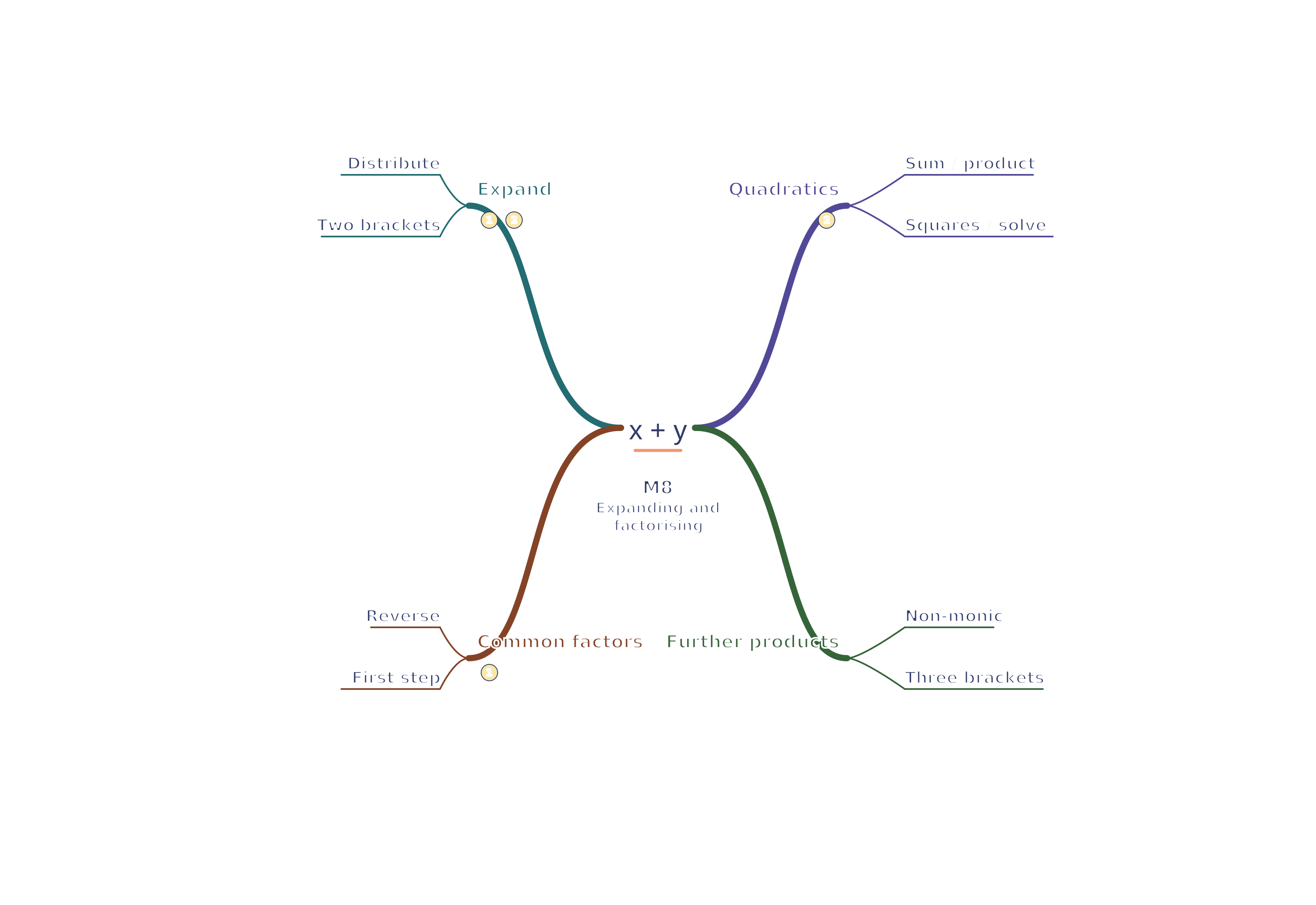
M8 M8 mind map: Expand, Common factors, Quadratics, Further products. A text version follows.
Open the full-size map to zoom. Download the PDF to print on A4 or enlarge to A3.

Open full-size map Download A4 PDF

Read the mind map as text

Expand

  • Distribute: Every inside term; outside minus changes every sign
  • Two brackets: Every term × every term; collect middle terms

Common factors

  • Reverse: 12x²+8x = 4x(3x+2); expand to check
  • First step: Higher: 2x²−18 = 2(x−3)(x+3)

Quadratics

  • Sum / product: x²+7x+12 = (x+3)(x+4); check signs
  • Squares / solve: a²−b² = (a−b)(a+b); solving needs equation = 0

Further products

  • Non-monic: Higher: 6x²+7x+2 = (3x+2)(2x+1); check middle term
  • Three brackets: Higher: Expand two first, simplify, then multiply third

Connections

  • Expand → Common factors: Factorising reverses distribution
  • Expand → Quadratics: Expanded coefficients check quadratic factors