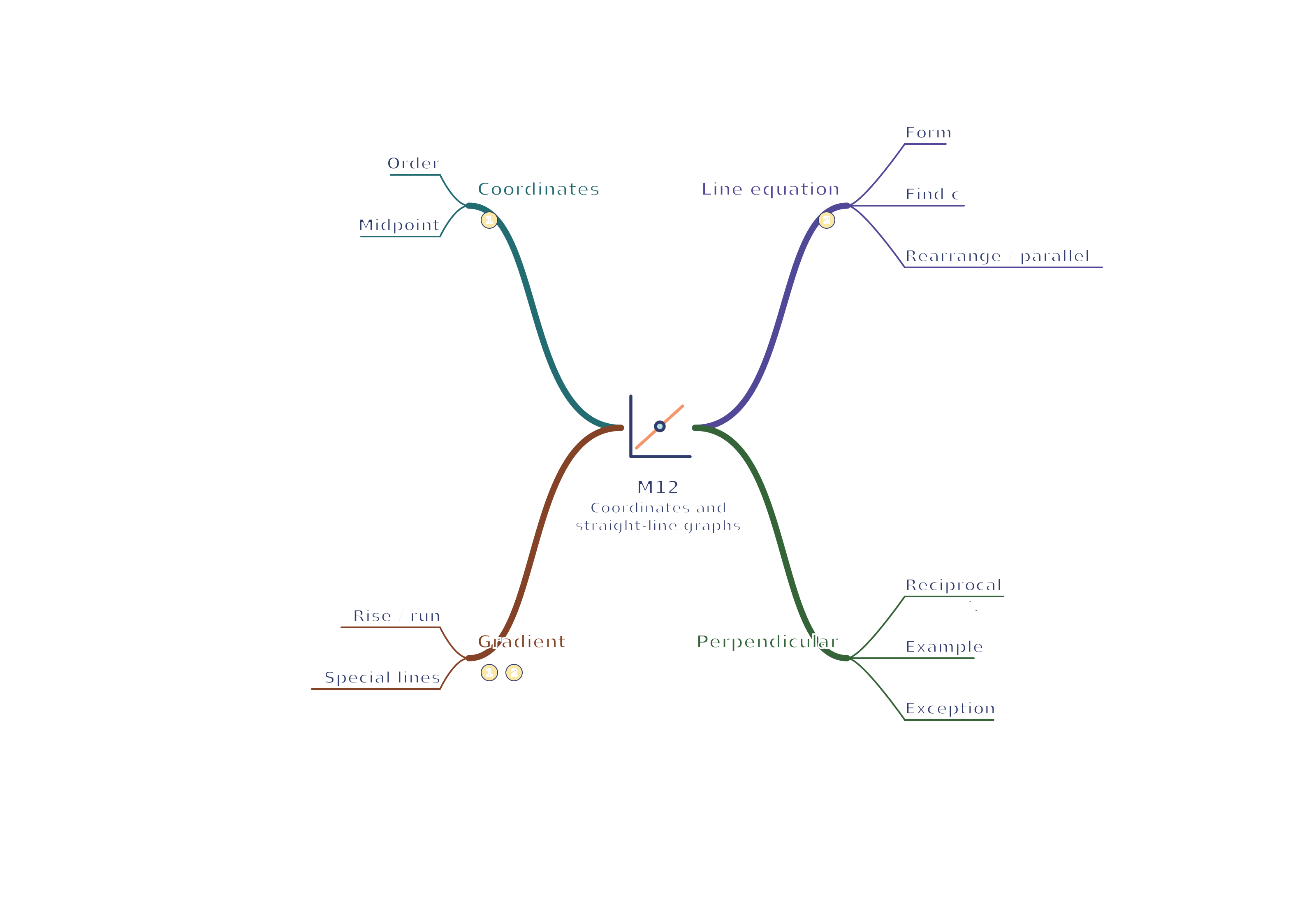
Revision notes, worked examples and methods for coordinates and straight-line graphs.
Notes and quizzes ready · 50 questions · Revision video ready.
Foundation shows shared notes and questions. Higher includes the shared content and labelled Higher extensions. Changing tier starts the notes and a new quiz set.
Revise the key ideas
Coordinates and gradients
Coordinates (x, y) give horizontal position first, then vertical position. In quadrant II, x is negative and y is positive; the origin is (0, 0).
The midpoint of (x₁, y₁) and (x₂, y₂) is (x₁ + x₂2, y₁ + y₂2). The midpoint of (−2, 3) and (6, 7) is (2, 5).
A straight line has constant gradient m = change in ychange in x. Use two well-separated points on the line; a positive gradient rises to the right. Graph of y equals two x plus one
Worked example: Through (1, 3) and (4, 9), m = 9 − 34 − 1 = 2. Subtract the coordinates in the same order in numerator and denominator.
In y = mx + c, m is the gradient and c is the y-intercept. y = 2x + 1 passes through (0, 1), and goes up 2 for every 1 across.
To plot a line, calculate a table of values and draw a straight line through the points. Check the intercept and a third point to catch errors.
A horizontal line is y = k and has gradient 0. A vertical line is x = k; its gradient is undefined because the horizontal change is zero.
Finding line equations
Worked example: A line with gradient 3 through (2, 5) has 5 = 3 × 2 + c, so c = −1 and its equation is y = 3x − 1.
For a line through two points, find the gradient first, then substitute either point to find c. Through (1, 3) and (4, 9), y = 2x + 1.
Parallel non-vertical lines have equal gradients. y = 2x + 1 and y = 2x − 5 are parallel; different intercepts make them distinct lines.
Rearrange another line form to identify gradient: 2y = 6x − 4 becomes y = 3x − 2, so the gradient is 3, not 6.
Higher — perpendicular lines
For perpendicular non-horizontal, non-vertical lines, gradients satisfy m₁m₂ = −1. Take the negative reciprocal: the line perpendicular to gradient 2 has gradient −12.
Worked example: Perpendicular to y = 2x + 1 through (4, 3): y = −12x + c. Substitution gives 3 = −2 + c, so y = −12x + 5.
A horizontal line is perpendicular to a vertical line. The negative-reciprocal rule should not be used by trying to divide by a zero gradient.
Test yourself
50 questions · Sets of 10 from the selected tier. For fractions, use / when typing; for powers, use superscripts or ^. Follow each question's answer format. These quick checks support revision; practise full written solutions and proofs too.
Watch M12 · Coordinates and straight-line graphs
Revise coordinates and straight-line graphs with this narrated video. Use the player controls to pause, seek, adjust the volume or mute. Turn English captions on or off using the captions menu.
 Mr Kidman's Classroom