Water security, increasing supply and sustainable water schemes.
Notes and quizzes readyOptional · choose 1 of 3
Named examples on this page are revision choices. Use your school’s examples if they differ.
Revise the key ideas
Water security and availability
Water security means reliable access to enough suitable-quality water for people, livelihoods and ecosystems. Having rainfall does not guarantee safe water at a household tap.
Water surplus and deficit vary between regions and seasons. Humid regions often have more physical supply, while arid regions face high evaporation and limited rainfall.
Physical water scarcity occurs when available water cannot meet needs. Economic scarcity occurs where investment or management is insufficient to provide access to existing supplies.
Population growth increases domestic demand. Economic development can increase industrial use, irrigated farming and demand for water-intensive goods.
Climate controls rainfall and evaporation. Drought reduces rivers and reservoir storage; floods can contaminate supplies rather than simply solve shortages.
Geology affects storage: permeable rocks can hold groundwater in aquifers, while less permeable rocks encourage surface runoff. An aquifer's supply depends on replenishment as well as capacity.
Pollution reduces the water suitable for use. Treating polluted water costs money and some contamination can persist in groundwater.
Over-abstraction removes water faster than it is replenished. It can lower water tables, dry wetlands and, near coasts, allow saltwater into aquifers.
Limited pipes, treatment plants or pumps prevent reliable access. Poverty can leave people unable to pay connection charges or repair damaged systems.
Impacts of water insecurity
Unsafe water and poor sanitation increase the risk of waterborne disease. Illness can reduce school attendance, productivity and household income.
Time spent collecting water reduces time for work or education. The burden often falls disproportionately on women and girls, but experiences differ between communities.
Crop yields and livestock health suffer when irrigation or drinking water is insufficient. This can worsen food insecurity and raise prices.
Industry may reduce output if water for processing or cooling is unavailable. Supply interruptions can discourage investment.
Shared rivers and aquifers can create disagreements between users and countries. Cooperation, treaties and shared monitoring can manage tensions; scarcity does not always cause war.
Increasing water supply
Dams and reservoirs store runoff for later use and may also provide hydropower or flood regulation. They can flood settlements, alter sediment movement and change downstream habitats.
Diversion channels or pipelines move water to where it is needed. Donor regions, environmental flows and competing uses must be considered.
Large transfers can support cities, farms and industry over long distances. Construction, pumping and maintenance are costly, and leakage or evaporation can reduce useful supply.Evaluating a water transfer. This is an evaluation framework, not a measured route map for Lesotho.
Desalination removes salts from seawater or brackish water. It provides an additional coastal source but requires energy and careful disposal of concentrated brine.
Groundwater wells can provide dependable local supplies when an aquifer is suitable. Pumping must stay within sustainable limits and the well needs protection from contamination.
Compare supply projects with demand management. Lower losses can sometimes deliver usable water more cheaply than constructing a distant new source.
A sustainable water future
Conservation includes leak repair, efficient toilets, water-saving irrigation and avoiding unnecessary use. Education and price signals work best alongside affordable practical alternatives.
Groundwater management monitors abstraction and recharge. Licensing, protection zones and limits can help prevent depletion and pollution.
Recycling treats used water for another use, such as irrigation or industry. The required treatment depends on the intended use and health risks.
Grey water is wastewater from sources such as showers and washbasins, rather than toilet sewage. Reuse requires suitable design and treatment; untreated grey water is not drinking water.
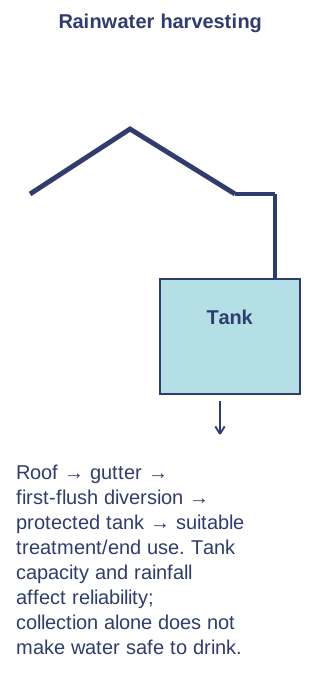
Rainwater harvesting collects roof runoff into tanks. A first-flush system, protected storage and treatment reduce contamination risks, while tank size and rainfall determine reliability.
Community schemes need trained operators, affordable maintenance and spare parts. Including marginalised households is essential if access is to improve fairly.
For a water scheme, explain the local shortage, the engineering and management response, the beneficiaries and the costs. Separate intended benefits from measured results.
Large water transfer: Lesotho Highlands Water Project
The Lesotho Highlands Water Project transfers water from mountain catchments in Lesotho towards South Africa's water-demanding industrial and urban heartland. Dams and tunnels store and move water across a national boundary.
Transfer supports users in the wider Vaal system, including the Gauteng region. Lesotho receives water-sale revenue, while the project's hydropower component supplies electricity.
Reservoirs and associated works have affected land, settlements and ecosystems. Resettlement and compensation, downstream river flows and construction impacts are important costs to evaluate.
Different phases have different dates and infrastructure. The established transfer is evidence of delivery; further development or projected benefits should not be counted as already complete.
Compare gains for distant consumers and national revenue with losses experienced by affected local communities. Agreements and monitoring help manage shared resources but do not remove every trade-off.
Local sustainable water: WaterAid's Beacon Project, Lahan, Nepal
The Beacon Project works in Lahan in south-eastern Nepal through a partnership involving the municipality, Nepal Water Supply Corporation, WaterAid and the Anglian Water Alliance. It aims to improve water, sanitation and hygiene, including access for marginalised communities.
Work on water networks, service management and community participation tackles infrastructure and access problems rather than relying only on a new source of water.
Reliable services need repairs, water-quality management and trained operators. Community involvement helps identify excluded households and supports accountability.
Better access can reduce unsafe-water exposure and time spent collecting water. Assess these mechanisms alongside affordability and continued maintenance; do not invent a universal health outcome or beneficiary total.
Test yourself
51 questions · Random sets of 10. These quick checks support revision; practise longer explanations and justified judgements too.
Watch G17 · Water
Revise water with this narrated video. Use the player controls to pause, seek, adjust the volume or mute. Turn English captions on or off using the captions menu.
 Mr Kidman's Classroom